
The Times We Need Each Other Most
Sunday Magazine
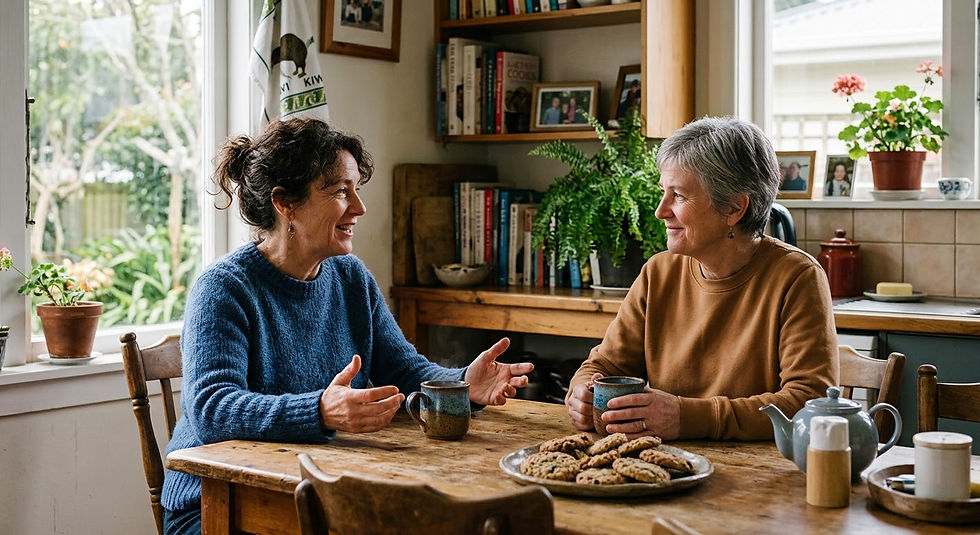
There are times in life when we need people.
Not necessarily lots of people. Not a house full of visitors or someone cheerfully telling us that everything happens for a reason. Sometimes we just need our people.
The person who remembers how we take our coffee. The friend who sends a message without expecting a reply. The person who says, “I was thinking about you today".
We tend to think of connection as something that belongs to the happy parts of life. Dinner with friends. Birthdays. Holidays. Catching up over coffee.
But some of the most important moments for connection happen when life isn’t going particularly well. When someone receives a frightening diagnosis. When a parent becomes less independent. When someone is recovering from surgery, grieving a loss, or adjusting to a life that suddenly looks different.
Or when nothing particularly dramatic has happened, but somewhere along the way, life has simply become a little smaller. These are often the moments when connection matters most.
We don’t always recognise loneliness
The word loneliness can conjure up a particular picture: someone sitting alone in an empty house, with nobody to talk to. But loneliness is more complicated than simply being alone.
The World Health Organization WHO, describes loneliness as the distressing feeling that comes when the relationships we have don’t match the relationships we want or need.
You can spend an entire Sunday happily by yourself, reading, gardening or pottering around the house. Being alone can be restorative.
And you can be surrounded by people and still feel completely alone.
Loneliness isn’t necessarily about the number of people in our lives. It’s about whether we feel connected to them.
The WHO’s 2025 Commission on Social Connection describes social connection as an important part of health and wellbeing across the whole of life - not simply an issue affecting older people. It’s a human problem.
Then life starts rearranging itself
Perhaps one reason connection becomes more complicated as we get older is that so much of it used to happen automatically.
We went to work. The children went to school. We chatted to other parents, saw familiar faces at the supermarket, had neighbours and colleagues. We didn’t necessarily have to plan our social lives.
Then life changes. We retire. The children leave. Work friends become former work friends. A close friend moves away. A partner becomes unwell.
It rarely happens all at once. Life can become quieter by degrees. And because there hasn’t been one dramatic moment when everything changed, we may not notice what we’ve lost until one day we realise: I don’t really see people anymore. Or perhaps the more confronting one: I miss who I used to be when my life was fuller.
Connection is not the same as company
We sometimes try to solve loneliness by simply putting people together.
More activities. More events. More things on the calendar.
Those things can help, but meaningful connection requires something more. It means feeling known, heard and valued, and having someone to turn to, somewhere we belong, and relationships that feel real.
That’s why sitting among twenty people at an event isn’t necessarily the same as sitting across a kitchen table from one person who knows you. Sometimes one good conversation can do more for us than an entire afternoon of small talk.
And then someone gets sick
Illness changes the landscape of connection. Suddenly, the ordinary question “How are you?” doesn’t feel so ordinary.
What do you say? How often should you call? Do they want to talk about it?
And perhaps the biggest question: What if I say the wrong thing?
It’s a very human fear. But while we’re worrying about saying the wrong thing, the person going through the difficult thing may simply be wondering: Why hasn’t anyone called?
Often, people become quiet because they care enormously. They’re frightened, unsure what to say and worried about intruding. So they decide to give the person some space. And then a day passes. Then another.
The intention was kindness. The result can sometimes feel like absence.
Asking can be surprisingly powerful: “Would you like some company, or would you rather have some quiet today?” Giving someone that choice can be a form of care in itself.
You don’t have to fix it
Difficult experiences aren’t always problems that can be solved. Sometimes they’re things that have to be lived through. Perhaps your job isn’t to make the person feel better. Perhaps your job is to make sure they don’t have to feel terrible alone.
You can listen without producing an answer. Bring food. Take someone to an appointment. Watch something completely ridiculous together.
When someone is ill, life can become very medical. Appointments, test results, medications and waiting. Connection can remind someone that underneath all of that is still the person who loves terrible jokes, has strong opinions about how tea should be made and would quite like to talk about something other than their health.
The middle bit is often the loneliest
The beginning of a crisis often brings people together. There are calls, messages, meals, visits and offers of help. And then, quite naturally, life moves on.
Other people’s lives continue. Work continues. Children need things. The news moves on to something else.
But the person in the middle of the difficult thing may still be there. Still recovering. Still grieving. Still exhausted. Still trying to work out what their life looks like now.
With illness, this can be particularly noticeable. The first few weeks may be full of appointments and support, but treatment can last for months. Recovery can be slow. Sometimes the hardest part isn’t the dramatic beginning.
It’s the ordinary Tuesday six months later. That is when someone remembering you can mean an enormous amount. Because they haven’t forgotten about you.
The same thing happens with ageing
Something similar can happen as people get older.
There can be a tendency to think that if someone is still independent, they’re doing fine. But independence and connection aren’t opposites.
A person can love living alone and still want someone to pop in for coffee. They can enjoy their own company and still want to know that someone would notice if they didn’t answer the phone.
Life changes, such as retirement, moving, and bereavement can alter our social connections. Loneliness and social isolation can affect people of all ages, with consequences for health, wellbeing and quality of life.
Perhaps the answer isn’t to treat older people as fragile or assume they’re lonely. It’s simply to keep including them.
Ask their opinion. Invite them. Call them. Listen to their stories.
And if you’re the one who needs connection?
This part matters too.
What if you’re the person who is lonely, exhausted, or going through something you don’t know how to explain?
You don’t have to wait for someone to notice.
You can say, “I'd love to catch up for coffee.” Or "Let's catch up for a walk".
You don’t need a dramatic reason.
You don’t have to earn someone’s time by being in crisis.
And you don’t have to apologise for wanting company.
We’re human beings. We’re not actually designed to do all of life by ourselves.
Who have you been meaning to call?
There is probably someone.
The friend you’ve lost touch with. The parent you haven’t called this week. The person going through treatment. The neighbour you haven’t seen lately.
Maybe send them a message.
It doesn’t need to be profound. Just say hello. Tell them something made you think of them. Ask how they are. Send a photo. Invite them for coffee.
Because connection doesn’t always arrive with a grand gesture.
Sometimes it arrives quietly, in a text message, on a doorstep, across a kitchen table, in a handwritten note, or in a parcel that arrives on a day when someone wasn’t expecting it.
And perhaps that’s what we need from each other more than we realise.
Just to reach across the distance, whatever that distance happens to be, and say:
I’m here.
And sometimes, that is enough. 💛
Thinking of someone going through a difficult time?
Sometimes a little reminder that you're thinking of them can mean more than we realise.
➡️ Thoughtful gifts for someone going through a tough time


Comments